
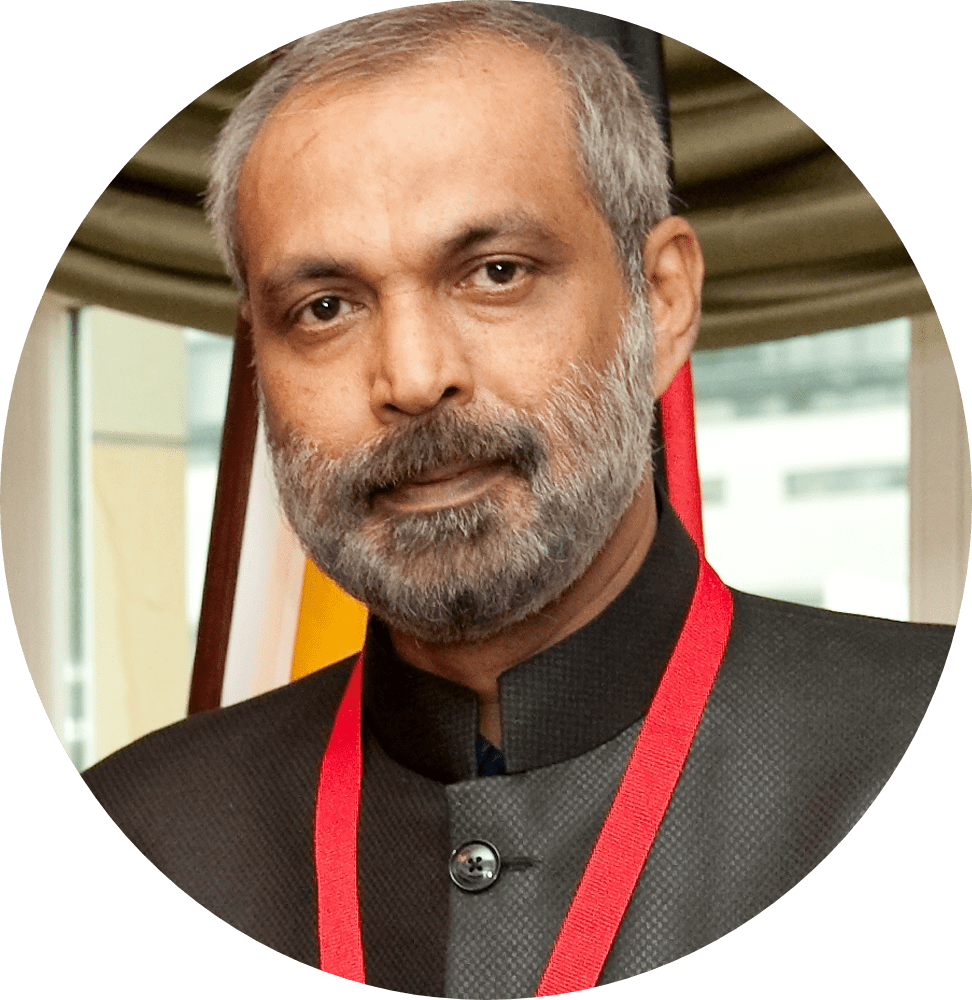
Sudhanshu Mani retired in the apex grade of GoI from the Indian Railways (IR) Service of Mechanical Engineering as General Manager, Integral Coach Factory, Chennai after serving IR for 38 years. He also served as Railway Advisor in the Embassy of India, Berlin for 3 years, interacting with railway systems of advanced countries world-wide on behalf of IR. A graduate engineer in Mechanical and Electrical engineering, he is also a Fellow of Institute of Mechanical Engineers, London IMechE). Hindustan Institute of Technology and Science, Chennai and Sir Padampad Singhania University, Udaipur, have conferred upon him the degrees of Doctor of Science (Hon.) and Doctor of Philosophy (Hon.) respectively.
He led the Train 18/Vande Bharat project, the first ever indigenous semi high-speed train of India, from concept to delivery. His journey in leading and completing this unique project is recounted in his best-seller book, ‘My Train 18 Story’. He has authored six more books, including four on a subject of his special passion, art and railways, and one each on greening of environment and collation of the works of Ghālib and Shakespeare and two more books are works in progress.
After retirement, he is engaged in advisory role in the corporate world, including technical, strategic and investment consulting.
Apart from his intense work as a consultant, he is also engaged in multiple activities like serving as Co-Editor for niche magazine Rail Business and on Advisory & Editorial Board of leading Railway & Metro journals, organization of Awadh Conclave (a festival of free thought), Keynote/stand-alone speaker and panellist on platforms such as IIMs, IITs, TEDx, PMI, AIMA & CII conferences, anchor for news analysis, art and culture on YouTube channel thepublic.india and promotion and curation of Visual Arts in association with a prominent art gallery of Lucknow. He runs a ‘not for profit’ art and culture centre, Manis’, and presides over Rolling Cars’ Society, which promotes technical awareness. He writes opinion pieces regularly on national issues of engineering and project management in leading newspapers, journals and portals, like, The Hindu, The Hindu Business Line, Deccan herald, Moneycontrol, PSUWatch, FPJ, IRJ, and The Pioneer and in addition, on these subjects and current affairs, art and literature in his blog.
What was the inspiration behind creating Train 18, nowadays christened as Vande Bharat Express? From concept to design, to engineering, to manufacture and validation, what was the most challenging?
Despite its vast network and engineering prowess, Indian Railways (IR) had long lacked modern, fast, and aesthetically pleasing trains. I had always felt this gap deeply and dreamt of India building its own state-of-the-art train set — like those in other countries with large networks, or even smaller ones — with permanently coupled coaches in distributed power configuration without locomotive(s), equipment mounted underfloor with the entire platform used for passenger amenities. But the dream remained just that, a dream, an angst.
In 2016, when I was 29 months away from superannuation, I became eligible for promotion as a General Manager. Instead of seeking a posting as a zonal operational head, I requested for and got to head the Integral Coach Factory (ICF), Chennai, driven by this long-cherished vision. It was likely my final post before retirement, capping a 35-year career that included a rare stint in the Indian embassy of Germany for interacting with railways around the world, and got an opportunity to engage with developed systems in Europe and other advanced countries. This was my last chance to turn the dream into reality.
What I found at ICF was a gift —a stroke of great fortune: a spirited and capable team, hungry to break new ground. India’s supplier ecosystem was also ready, merely needing a nudge. All the essential elements — vision, talent, opportunity —were present, waiting to be forged into something transformative.
I will speak here not of the technical challenges, which the team handled with admirable competence and without much input from me, but of the human and leadership challenges we faced. You see, we were not reinventing the wheel; we merely had to negotiate and defeat bureaucratic inertia, and design and build something innovative in an ecosystem not always conducive to bold execution. The greatest challenge was persuading the Ministry to give ICF the mandate to design and build the train. Despite the negativity and scepticism that prevailed — partly due to entrenched jealousies and partly due to plans for imports — it was Mr. A.K. Mital, the then Chairman Railway Board, who ultimately allowed us to go ahead with two trains.
Another major question loomed: whose technology would we use? We decided, for better or worse, it would be our own. Unlike the Transfer of Technology model we had long relied upon, we resolved to challenge ourselves — and whether we failed or succeeded, we knew the road ahead could only lead to success. After all, it is always easier to improve your own baby than to tinker with someone else’s.
Having made that choice, we needed to be — to borrow from Shakespeare’s Twelfth Night — a ‘witty fool,’ not a ‘foolish wit.’ In matters of engineering design, we went forward boldly in areas where we had confidence or could build capability with extra effort, but we were equally unafraid to acknowledge where we fell short. We identified three critical areas that required hand-holding and brought in consultants — not large firms offering proprietary technologies, but smaller ones specializing in design consultancy. The caveat was non-negotiable: everything they did had to be done in collaboration with ICF’s technical staff, so that the next time a better train needed to be designed, our own team would be fully capable of doing it independently.
With that in place, the biggest challenge became the timeline — which I have spoken about elsewhere. Concept to design to engineering to manufacturing to testing and validation are serial activities, which usually take 36 to 42 months. This would mean that I would retire in December 2018, and the next leader might be averse to taking the risk of home-grown technology and could abandon the project. We decided that we would burn the midnight oil and attempt something that appeared almost impossible: turn out the train before my retirement, which gave us just 21 months from concept to delivery. We named it Train 18 so that everyone would always be aware that the train had to be out in calendar year 2018. There were hitches and glitches at every step, but they were overcome through committed synergy. Thanks to the stupendous work of the team, the train lived up to its name in every sense — not only was it completed in calendar year 2018, but the entire journey from concept to reality spanned just 18 months, from March/April 2017 to October 2018.
During your vast experience, you have observed many colleagues of the railway field, both from India and the international community. Could you mention at least one feature that describes best the majority of railwaymen, the rolling stock engineers – and has remained constant over the years?
Thanks, that’s an unusual question but I am happy to answer it. Yes, I have interacted with railwaymen all over my life, In India and abroad. „If there’s one thing that binds railway men across generations, it’s their deep-rooted sense of the music of moving trains — come rain, derailment, or deadline. Tracks may change, systems may modernize, but the railwayman’s heartbeat still syncs with the rhythm of a passing train. Railwaymen, whether in steam days or the digital era, have always shared one unwavering trait: an almost sacred pride in keeping the wheels turning. It’s not just a job — it’s a calling etched in grease, grit, and glory.
Specific to rolling stock engineers, they usually have an unshakable obsession with wheels turning flawlessly. We’re a tribe that sleeps with the hum of bearings in our ears and wakes up thinking about throttles, brakes and bogies. More specifically about manufacturing, through changing technologies and times, one trait remains eternal among them — a fierce pride in creation. Give them steel, sweat, and a sketch, and they’ll give you a train. The romance of building something that moves a nation – that’s what keeps us all going.”
What are the most recent projects that involve you as a consultant?
I believe the role of a consultant is essentially advisory, and in such a position, a certain level of detachment is necessary, unlike in an executive leadership role, to avoid possible disappointments — after all, it’s quite possible that your advice would not be accepted, in part or in full. I always do my best to present my views clearly but refrain from pushing them beyond a certain point. Early on, I decided to keep away from government circles as I have had enough of that all my life — not that I was being strongly courted as an advisor — but to stay connected with my profession, I chose to consult with private entities instead. As a result, I am associated with several companies in the rail domain, on limited time basis, working both on complete train delivery and on the development of individual components.
2025 is going to be regarded as the most favourable year for the Indian Railways of the last decade, just in terms of infrastructure. But what does the future hold?
Shakespeare, through Volumnia in Coriolanus, said: “Action is eloquence”. Your work should speak for itself; you should not begin speaking about it even before it’s complete. Unfortunately, there is a tendency to hype things on IR. IR has a great team of executives and staff, they are amenable to work for great things, the leadership should channelize their energy towards project which challenge them and I can tell you, great accomplishments can follow.
Although the financial health of the Railways is far from robust — even as India’s economy grows at nearly 7% — Indian Railways struggles to compete with roads in the freight segment and with both roads and air travel in the passenger segment. However, the government believes that the Railways’ finances should not be viewed in isolation. Its economic and environmental benefits are so substantial that the government continues to invest heavily — approximately $30 to $35 billion annually — in railway projects.
It is now up to the Railways to make effective use of this investment. Rather than focusing on vanity projects, priority should be given to the fast execution of initiatives such as high-speed rail, freight reforms including dedicated wagons and tariff restructuring to attract non-bulk freight, augmentation of track capacity, the proliferation of the indigenous signalling system Kavach — India’s equivalent of ETCS Level II — and significant improvements in passenger amenities, especially in the lower classes.
You have explored diverse aspects of railways, from designing Diesel locomotives to bringing art and railways together. Have you matured a philosophy of life through these decisions and contributions?
Thank you. Yes, the Railways was, is, and shall always remain my first love. Yet, I must confess, beyond the world of trains and tracks, I’ve discovered even deeper joys. I write for newspapers and online platforms, albeit mostly about railways, co-edit a railway business magazine, write books on poetry of great poets, pen blog posts on my page, promote the visual arts, and curate workshops and conclaves on free speech. Most recently, I produced a musical — and even took to the stage myself. Life after retirement, indeed, has been very kind.
I lay no claim to have achieved any philosophical stature, but if your readers are nearing retirement, let me offer this simple truth: life does not end at retirement — it unfolds. A regular job, for all its dignity, often fences us off from paths not taken. Post-retirement life, in that sense, is a new morning — soft with promise, radiant with possibility. Prepare for it while still in service. And once it arrives, give it your all — for it holds the chance to live not just one life, but many.
Acest material a fost realizat cu acordul și sprijinul lui Sudhanshu Mani.
 Actualitatea Feroviară
Congratulations! The interview is original because it is full of metaphors.
ApreciazăApreciază