
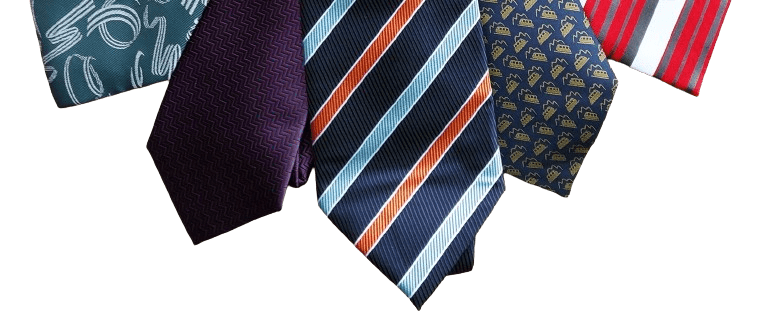
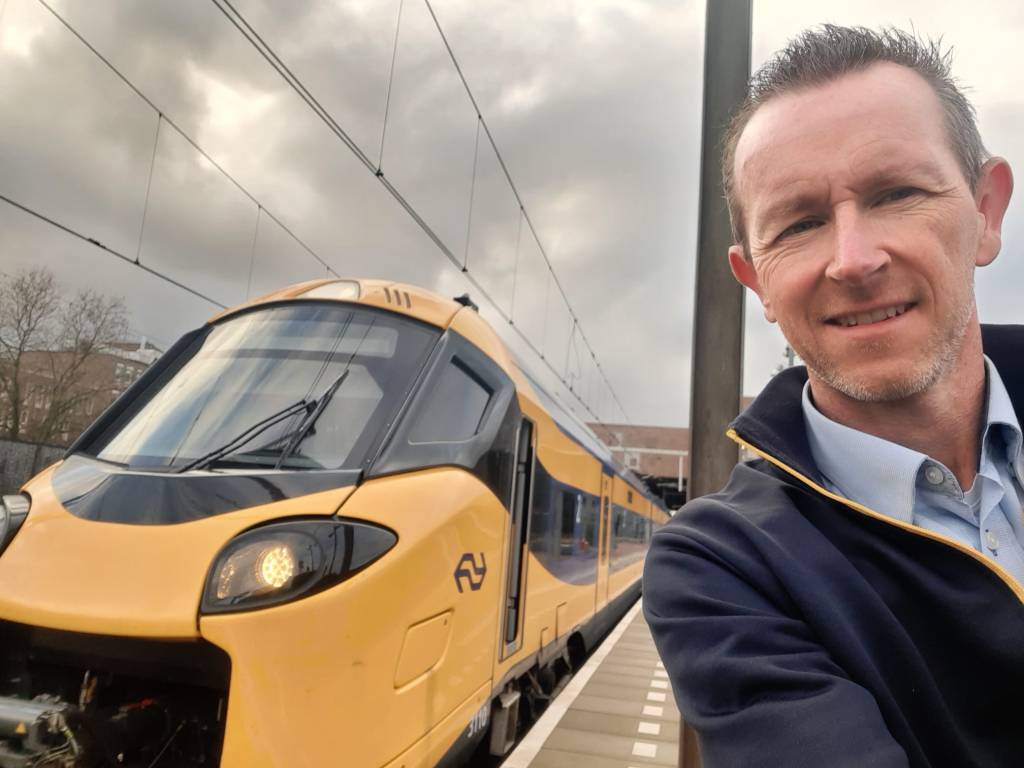
Since 2001, Michel Velders has been working as a train driver at Nederlandse Spoorwegen (NS), a position he has held with „great pleasure for nearly 25 years”. His driving license is issued by the government and is valid for both the regular railway network and the high-speed line (HSL) within the Netherlands.
Michel is specialized in passenger transport, driving only electric rolling stock, including the Traxx locomotive, ICNG, ICM, SNG, SLT, VIRM, and DDZ (https://treinposities.nl/materieel/NS). To maintain his professional competence, he is undergoing a medical examination every four years and a psychological evaluation every five years. „Safety, precision, and the connection with the railway world are what make my job fascinating every single day.”

What inspired the inception of collecting ties from railway uniforms world wide? What is the mechanism behind the act of collecting? Has this passion come to evolve into different meanings, such as a metaphor of international collegiality?
It actually started as a spontaneous joke — or maybe more accurately, a small challenge. During a holiday in Italy, I brought along an NS tie, intending to trade it with a fellow train driver from Trenitalia. That turned out to be not so simple; first, you have to start a conversation, build trust, and only then might such a trade happen. But it was precisely that interaction that made it interesting. We started talking, and I noticed how many similarities there are in the way we work, despite language and cultural differences — from timetables to tools and safety procedures.
Since we usually vacation in Italy, it became difficult to trade in person with train drivers from other countries. So I started contacting railway companies across Europe through their websites. I searched for contact details, sent emails explaining my story, and asked if they’d like to contribute to my collection.
What began as a fun little gesture has grown into something more meaningful. Each tie represents a colleague, a country, a railway culture. It’s not just a piece of fabric — it’s a symbol of international connection within a shared profession. In that sense, it really has become a metaphor for collegiality across borders.
Have you ever received a tie that is „tied” to a memorable story? What is your most unforgettable experience as a collector?
The first tie will always be the most special — that personal trade in Italy, the moment it all began. But one of the most remarkable ties I’ve received is from the Russian Railways: Rossijskie zjeleznye dorogi (RZhD). I received it by post after submitting a request through their website. That was no easy task: the war with Ukraine had already started, and I had to use a VPN just to access their site. Eventually, I asked for a mailing address, and five months later, an envelope from Russia appeared in my mailbox.
That’s what makes it so special to me. Despite all the “shit” happening in that region, as I call it, there was still a form of connection possible. Railways, in a way, transcend politics — colleagues remain colleagues, even when they live on the other side of a conflict. That touches me deeply, and it’s exactly what makes this collection so meaningful.
Tell us more about a day in the life of a Dutch train driver. What is your daily routine?
No day is ever the same — and that’s probably the best part of this profession. My workday starts at my base location in The Hague, where I log in via an app to check in and view my assignments for the day. I check for any special notices, such as maintenance work, speed restrictions, or schedule changes.
I work a roster with double irregular shifts, which means I only work evenings and nights. No two days start or end at the same time, and that requires a lot of flexibility — both mentally and physically.
Next, I head to the train on the designated platform, and together with the conductor, we depart at the scheduled time. That’s when the real work begins: driving according to the timetable, always prioritizing safety. I constantly monitor the signals, speed limits, and any potential disruptions on the track. The work can seem repetitive at times, but it can instantly shift into a situation that demands complete focus — for example, when unexpected events occur en route.
During a shift, you often operate multiple routes, sometimes with different train types. There are also breaks, usually at larger stations where you can rest for a bit or catch up with a colleague. At the end of the shift, I check out. Then I head home — often with the satisfying feeling that I’ve quite literally helped people on their way. And that remains something truly special.
Considering your knowledge of the international railway community, how would you define the Romanian railways in relation, or in contrast with other European railways? What can be done to improve the current state of rail system in Romania, from being less competitive and not modernized?
That’s a difficult question. I think it’s hard to directly compare the Romanian railway system to, for example, the Dutch one. The Netherlands is a small and densely populated country where a large number of commuters rely on public transport every day — mainly because the highways are often congested. The railway plays a major role in daily commuting here.
In Romania, the situation seems different. I assume train travel is less commonly used for daily commuting. That’s something that needs time to develop — a process of growing demand and supply. When there’s more demand for reliable public transport, the supply will need to grow with it, and vice versa.
What would help, in my opinion, is better connectivity between cities with fast and frequent train services. In addition, having accessible and well-connected stations, with smooth transfer options, is essential to make train travel more appealing to the public.
If you were to fulfill the target of collecting ties from railway colleagues around the world, what will be next? Would you manage an exhibition of „railway memorabilia”, write a book on your experience or just move on with life?
Funny that you ask — I was just talking about this with a friend recently. I asked him: „Do you think there would be a market for a book?” Just collecting ties on its own might not be exciting enough. You’d really have to broaden the story — paint a complete picture of the railway world, the differences between countries, and the uniforms of railway staff.
The connections I’ve made through this project have been truly enjoyable. Some railway companies are genuinely honored that I reached out and get really enthusiastic about it. Lately, I’ve noticed that many of them want something in return — for example, a photo of my collection with their tie included, or even a picture of me wearing their tie with my own uniform, to be used on their intranet. That’s fun, and those little stories would make great material for a book. This interview, actually, would fit right in.
Acest material a fost realizat cu acordul și sprijinul lui Michel Velders.
 Actualitatea Feroviară
Interesting interview! Congratulations on your job!
ApreciazăApreciază